The Human Blueprint: Timeless Foundations from the Dubai Future Forum
Reflections from the Dubai Future Forum 2025. To imagine how we want the future to look like, we must reimagine the present. This article expands on my conference notes about personal foresight, healthspan, and the next generation's demand for action over talk. It's playtime!

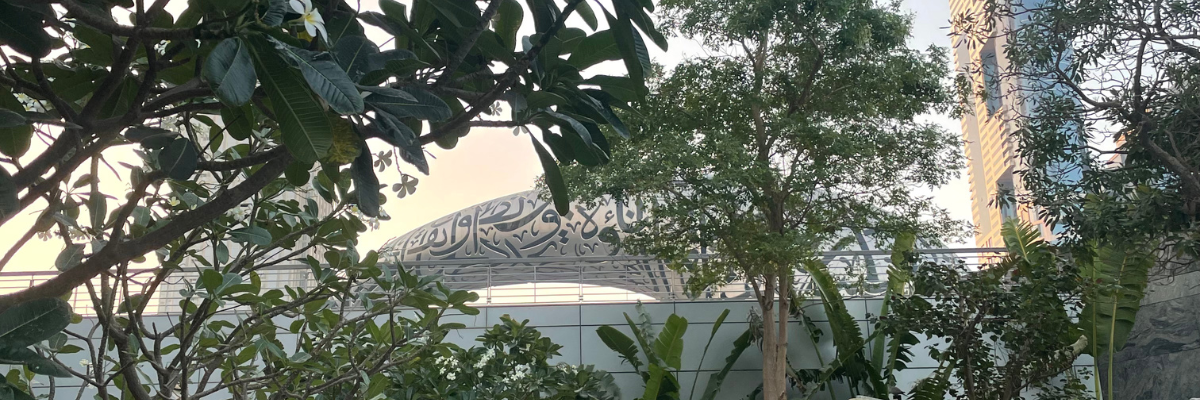
As inspiration settles into action one week after the Dubai Future Forum 2025, I finally have space to share my expanded thoughts based on the many notes I jotted down in my notepad.
I feel incredibly lucky and humbled to have been invited to take part in the conversation as one of the 2500 participants. Huge gratitude to the whole team and the Dubai Future Foundation for an experience that genuinely elevates global foresight. It was an honour meeting so many incredible people and minds over the past few days.
The future isn't just about what we predict—it’s about what we build.
No surprise, the topics that interested me the most were all connected to the human being as the central actor of the future. Technology might be the stage, but the human mind and spirit are the lead players.
Exploring the Unknown
Beyond the usual, but necessary, conversations on AI and climate, the discussions on pushing the boundaries of human perception truly resonated with me.
From my perspective as a coach and martial artist, exploring the unknown begins within. Mastery is about expanding what the body and mind can sense and achieve. The most essential foresight comes from the personal work we do to build an intentional and resilient mind-body connection, which is the baseline for all external change. The future is forged by a fully sensed present.
Once we step into that flow, we can start to figure out how our personal vision fits into the larger societal puzzle, from families to neighbourhoods, to countries, to the global scale.
And speaking of puzzles, let us not underestimate the power of play. Play is a great toboggan into thinking about overly serious topics. The core skills we need to craft that future are rooted in personal readiness. Only by cultivating internal awareness and confidence can we navigate external uncertainty.
Empowering Societies
Being part of the intergenerational unconference, Tomorrow’s Children, Today’s Voices, was a major highlight. If we want future generations to build resilient societies, they need resilient minds and bodies today. This is the whole point of my work with children and youth through my Brain Kung Fu and martial arts classes: giving them the physical and mental foundations to not just adapt to, but shape the future.
Health isn't just about extending lifespan, but deepening healthspan
I joined the table on “The future of mental health for junior and senior citizens”, led by incredibly thoughtful mid-teens from all over the world. Together, we worked on a mini-manifesto for a kinder future. While the younger generation holds a fascinating spectrum of views—from dark and gloomy to eco-friendly cyberpunk—the consensus was clear: we need more community.
This realisation opens up many possibilities; it confirms that it's truly up to us to manifest the society we want. Most of us agreed on a non-negotiable need in transforming promises into commitments, requiring more action and less talk, and building policies based on human needs, not lobby interests.
- We need teachers who teach, not only parrot; students who learn skills, not only accumulate knowledge; and parents who educate, not only delegate.
- We need informed healthcare systems (less pharma lobby) and less concentration of power in the hands of tech moguls (No thank you, Neuralink!).
Reimagining Health
The discussions around longevity reinforced a core belief of my practice: Reimagining health isn't just about extending lifespan, but deepening health span—a focus Traditional Chinese Medicine has championed for millennia.
And on a final, foundational note from the manifesto: buy chicken. They’re good for your mental health and provide nutritious superfoods. It's the simple, tangible actions that provide the foundation for sustained well-being.
What about AI?
I thought you’d ask… Yes, there were a lot of talks about AI, its potential, limitations, dangers, benefits, and everything in between. Quite frankly, this was not part of my central focus for this conference.
Lucky me, I naturally gravitated towards people who seemed to share this common take. As conversations unfolded, AI quickly took its rightful place in the background as a tool to be embedded rather than the central topic. And we could move on to debating more exciting human-centred endeavours.
Anecdotes and food for thought
As we were building the "typical day" of a child in 2040 as part of the future of mental health focus group, I noticed that activities involving movement (whether through play or sports) were left out.
The first scary thought that emerged from the conversation was that, in 2040, food would come in the shape of pills. No need to cook, no need to chew, just take it and done. I jumped in with a few other people at the table explaining the importance of healthy food, well-balanced nutrition and good eating habits cannot be compromised, as it’s a central pillar to support our well-being.
As I expanded onto another essential pillar, the importance of incorporating physical activity as a non-negotiable part of the day, I received two reactions that struck me.
The first, from one of the oldest participants, way past his mid-50s, insistently questioning what I mean by "physical activity"? I kindly explained that moving well, on a daily basis, is obviously critical to health, including mental well-being. I gave the example of fitness, a sports hobby such as football, or any playing or hobby that involves movement, and ideally outdoors.
The second, from some youngest people at the table, reacting to my previous point, said they could play football on their consoles. I validated that as a hobby, but the purpose of my point wasn’t to “spend time”—although that is a byproduct. Instead, we should acknowledge that our mind can only be fully healthy if we have a healthy body, and vice-versa.
This is the whole point of my work with children and youth: [...] giving them the physical and mental foundations to not just adapt to, but shape the future.
This exchange stuck with me for the past week as it gave me food for thought. Most education systems around the world are focusing on embedding digital literacy, some are trialing incorporating financial literacy, and many want to implement AI as a subject starting age five.
Perhaps we should rethink about how we can embed health literacy and well-being hygiene now, so we don’t have to deal with drastic consequences in the (nearer than we think) future.
Time for action
I have learned immensely from the global perspectives shared at the Forum and am grateful for those of you with whom I had the chance to debate my take on how ancient Eastern wisdom can be an important root that will nurture a healthy version of tomorrow's humanity.
It's the simple, tangible actions that provide the foundation for sustained well-being.
The future isn't just about what we predict—it’s about what we build.
So let us cultivate the Dragon Within so we can navigate complexity with resilience and clarity.
Which single action do you think we need to take today so we can build this envisioned future for tomorrow's children?
Now it’s time to integrate and get back to work! 🐉
The future of leadership is rooted in internal mastery.
If you are a high-achieving leader, founder, or change-maker, you know that sustainable success and foresight depend on mastering the human core—the mind, the body, and the spirit.
I combine modern neuroscience and transformative coaching with the timeless resilience principles of Traditional Chinese Medicine and martial arts to bridge the gap between ambition and vitality.
Ready to build the physical and mental baseline that future-proofs your leadership?